Architecture (VMAX)
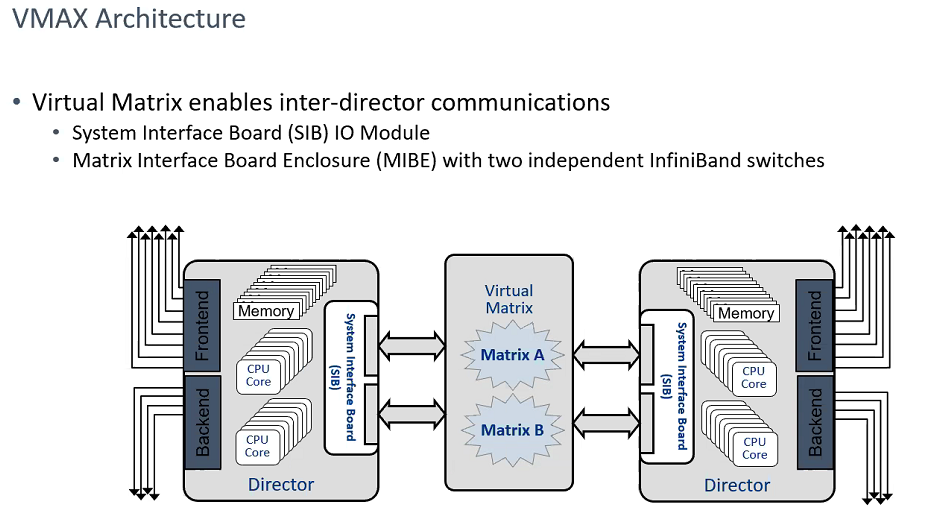
- Cores allocation - put cores behind certain emulation functions
- Hard wired connections replaced with virtual matrix
- started out with Rapid IO - Infiniband wasn't reliable enough
- Infiniband is found on VMAX3
Engine - Enclosure made up of two directors
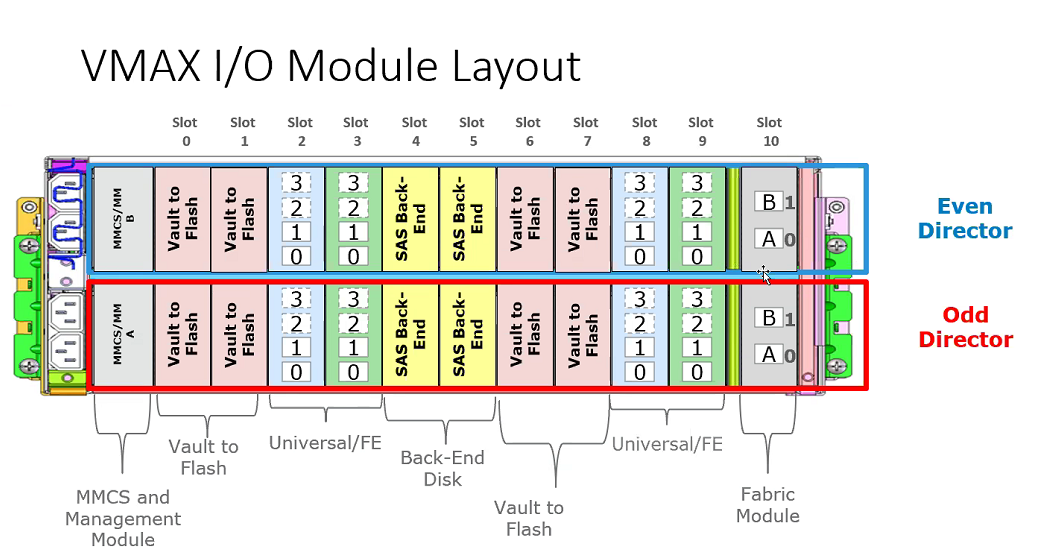
- Made up of 2 directors
- Even Director and Odd Director
- Single engine system = single enclosure
- Flexible SLIC's identified in the impl bin file
- 2 MMCS management modules
- MMCS1 - Primary MMCS used for interaction with the Symmetrix
- MMC2 - Secondary MMCS, only used for recovery of MMCS1
- Each director is an intel based compute resource
- Runs processors
- Runs memory
- All chipsets to run IO
- Vault drives
- Dedicated devices on the first direct connect devices (Earlier VMAX design) - First 5GB of every drive was vault capacity
- VMAX3 started using Vault to Flash SLICs
- Protection for the mirrored slots in the CACHE to protect written data not yet destaged to disk
- CACHE is used for user data
- Writes are mirrored for protection
- Reads are unmirrored because it is stored on the physical disks
- Fabric Module
- Connectivity to nodes or other engines within the system
- Older models had different boards for different connections
- Flexible slots for the NICs, driven by different emulations
- Front End host connections
- Back end disk connections
- Management interfaces
- Infiniband connections are for communication between engines (slot 10)
- Redundancy from the host to the front end connectors of the engines is done at the host level. Using a multi-pathing type tool or Powerpath to map redundant connections to the VMAX
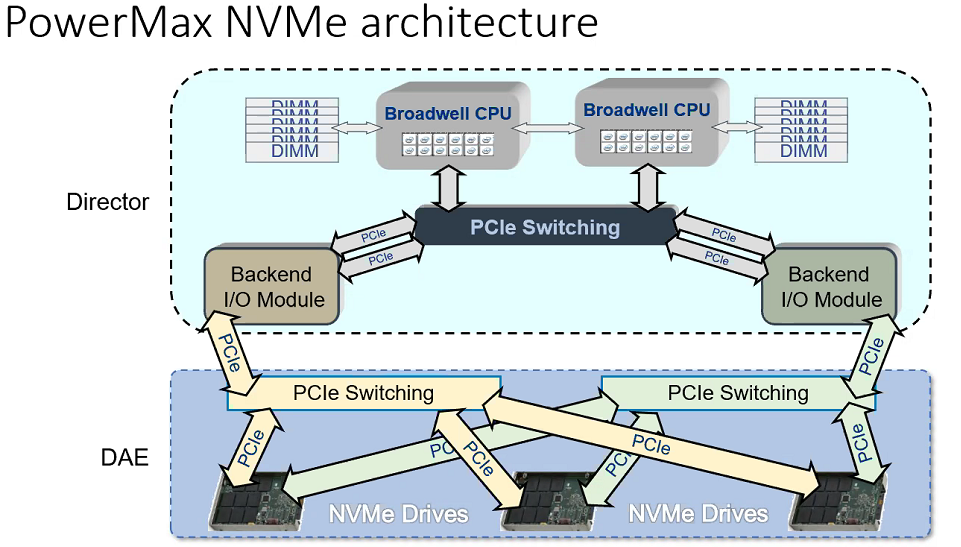
Powermax uses NVMe architecture